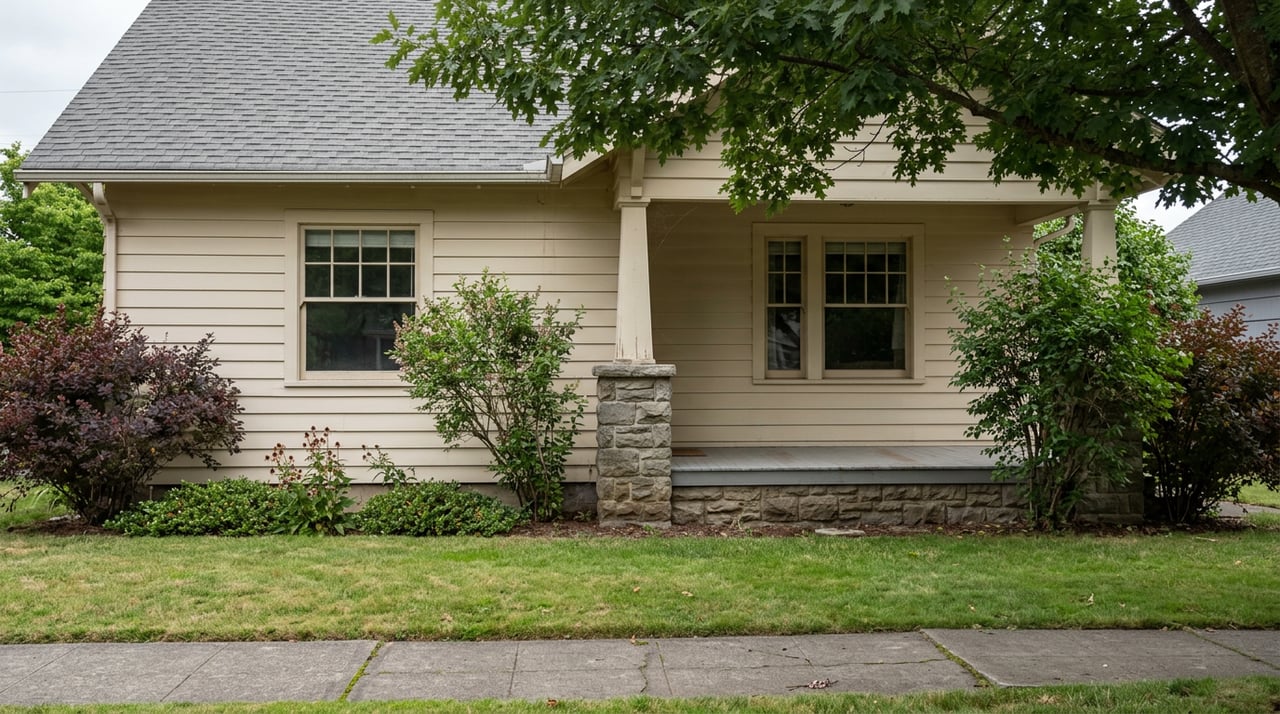
Somewhere in Rockwood or Manito, a buyer who just got their offer accepted on a 1912 Foursquare is about to spend more time on the phone with an insurance agent than with their real estate broker. Not because the deal is falling apart. Because the wiring behind the plaster walls was installed before anyone thought to add a ground.
That's the part of buying an older South Hill home that the median sale price doesn't tell you. And right now, the median is telling a story that sounds like good news for buyers: prices are down. Over the three months ending May 2026, South Hill's median sale price came in at $590,000, down 2.6% from the same period a year earlier. If you stopped reading there, you'd assume the hill has softened and you have more room to negotiate than you did last year.
You'd be reading the wrong number.
The Number Everyone's Quoting
Look one line further down the same data and the story flips. Price per square foot in South Hill was $293 over that same window, up 1.9% year over year. Homes were still selling in about 18 days on average, receiving roughly one offer each, and closing at or near list price. That's not a cooling market. That's a market where buyers are paying more per square foot for less total house, on average, than they were a year ago.
Compare that to Spokane as a whole. Citywide, the median sale price over the three months ending June 2026 was $376,000, down 1.2% year over year, with homes selling in around 15 days. South Hill's price drop is steeper than the city's, and its per-square-foot gain is stronger than the city's overall pace. Whatever is happening on the hill is happening on the hill specifically, not to Spokane generally.
| Metric | South Hill (3 mo. ending May 2026) | Spokane citywide (3 mo. ending June 2026) |
|---|---|---|
| Median sale price | $590,000 (down 2.6% YoY) | $376,000 (down 1.2% YoY) |
| Price per square foot | $293 (up 1.9% YoY) | $197 (down 2.5% YoY) |
| Typical days on market | 17-18 days | 15 days |
| Offer pattern | Near list, roughly 1 offer average | Near list, competitive |
A median price and a price-per-square-foot figure moving in opposite directions is not a contradiction. It's a composition change. Something about which homes are selling, and at what size, shifted enough to pull the average price down while pushing the per-square-foot number up.
What the Median Doesn't Show You
South Hill isn't one housing stock. It's several, stacked by decade as you move across the bluff. Rockwood carries some of the largest lots and oldest homes on the hill, many with real historic significance. Manito's streets surround the park itself, with homes dating to the early 1900s. Cannon Hill mixes American Foursquare, Tudor Revival, and Craftsman bungalows from the same era, anchored by Cannon Hill Park. Cliff-Cannon blends historic houses with newer apartment construction closer to downtown. Lincoln Heights, further south, has a broader mix that includes ranch-style homes and more recent builds.
That range matters because it's not evenly distributed by price or by system age. The oldest, largest homes concentrated in Rockwood and Manito are exactly the ones most likely to still carry original wiring, original plumbing, and single-pane windows. They're also the ones most likely to sit on the market longer or sell at a discount relative to their square footage, because a buyer evaluating one of them has to price in a wiring problem before they can even get to the negotiating table.
Meanwhile, a smaller, already-updated home in Cannon Hill or Lincoln Heights doesn't carry that friction. It can command a premium per square foot precisely because the buyer isn't staring down a rewire and an insurance scramble. Read the two data points together and the pattern makes sense: the market isn't cooling on South Hill, it's repricing around which homes have already solved their infrastructure problem and which haven't.
The Wiring Problem That Shows Up After You're Under Contract
Pre-1930 construction on the hill commonly carries deferred-maintenance realities that newer-construction buyers aren't used to underwriting: original plaster and lath, single-pane windows, and in a meaningful share of cases, active knob-and-tube wiring. None of that is disqualifying on its own. But knob-and-tube specifically creates a problem that has nothing to do with the seller and everything to do with your lender's closing timeline.
Knob-and-tube wiring has no ground wire, which means a damaged conductor or an overloaded circuit has nowhere for stray electricity to go except into heat and sparks. Standard homeowners insurance carriers in Washington generally won't write a new policy on a home with active knob-and-tube. The alternative paths are a surplus lines policy, usually at two to three times standard premiums with a higher deductible and a contractual deadline to complete a rewire, or a state FAIR Plan policy as interim coverage while you schedule the work. Either way, your lender needs proof of insurance before they'll let you close, which means this isn't a problem you get to solve after moving in. It's a problem that lands inside your financing contingency window, while the clock on your purchase agreement is already running.
The rewire itself isn't cheap. A full rewire of a 1,200 to 2,000 square foot house commonly runs $8,000 to $20,000 or more, depending on how much of the attic and basement are open for access. There's a second catch buyers rarely see coming: if you're planning to add attic insulation for energy efficiency, Washington's energy code and most insulation contractors won't blow it in over active knob-and-tube. The wiring has to be dealt with first, which means an energy upgrade you budgeted for separately just became part of the same electrical project.
None of this means walk away from a Rockwood estate or a Manito bungalow. It means the conversation with your insurance agent needs to start the week you go under contract, not the week before closing.
The Sewer Line Nobody Asks About Until It's a Problem
South Hill's tree canopy is one of the things people love about living there. It's also a maintenance variable for anyone buying an older home on the hill. Mature trees along streets near High Drive Bluff Park and around Manito Park send roots looking for moisture, and older clay or cast iron sewer laterals are exactly what they find. Local sewer inspection companies recommend scoping the line every 2 to 3 years for older homes, more often if mature trees sit close to the run.
For a buyer, the relevant window is your inspection period, not some future maintenance schedule. A camera sewer scope is a same-day service in most cases, and at least one Spokane provider, Spokane Rooter, offers a flat rate built specifically for real estate transactions with digital reports delivered within 24 hours. That turnaround matters when your inspection contingency has a deadline attached to it.
What This Means If You're Writing an Offer This Month
The instinct when you see a falling median is to assume you have leverage on price. On South Hill, that leverage is real for the oldest, largest, least-updated homes on the hill, the ones where a buyer has to solve a wiring and insurance problem before closing. It's much thinner for anything already rewired, replumbed, and move-in ready, which is exactly why those homes are commanding more per square foot even as the overall median drops.
If you're comparing two houses at similar price points on the hill, one already updated and one still carrying original systems, the sticker price gap may not be the real gap. Run the electrician's estimate and the insurance quote before you decide the fixer is the better deal. Sometimes it still is. Often the premium you'd pay for the updated home is close to what you'd spend solving the older one's problems anyway, minus the uncertainty about what else is behind the walls.
Does every South Hill home have knob-and-tube wiring? No. It's most common in homes built before 1930, concentrated in the older sections of Rockwood, Manito, and Cannon Hill. Many of these homes have already had partial or full rewires over the past century. A licensed electrician's evaluation during your inspection period is the only way to know for certain what's still active.
If the wiring was partially updated, can I still get standard insurance? It depends on how much was replaced and whether the remaining knob-and-tube is documented as inactive. Some carriers will insure a home where an electrician certifies that all knob-and-tube has been de-energized and abandoned in place. A standard home inspector's report alone usually isn't enough for an underwriter. You'll want the electrician's letter in hand before you shop for a policy.
If you're weighing an older South Hill home against something newer, or trying to figure out what a specific rewire or sewer finding actually means for your offer, Katie McDaris has spent 17 years walking Spokane and North Idaho buyers through exactly these decisions. Schedule a Consultation to talk through your specific address before you write the offer, not after.